Skip to content ↓

Learning Outcomes

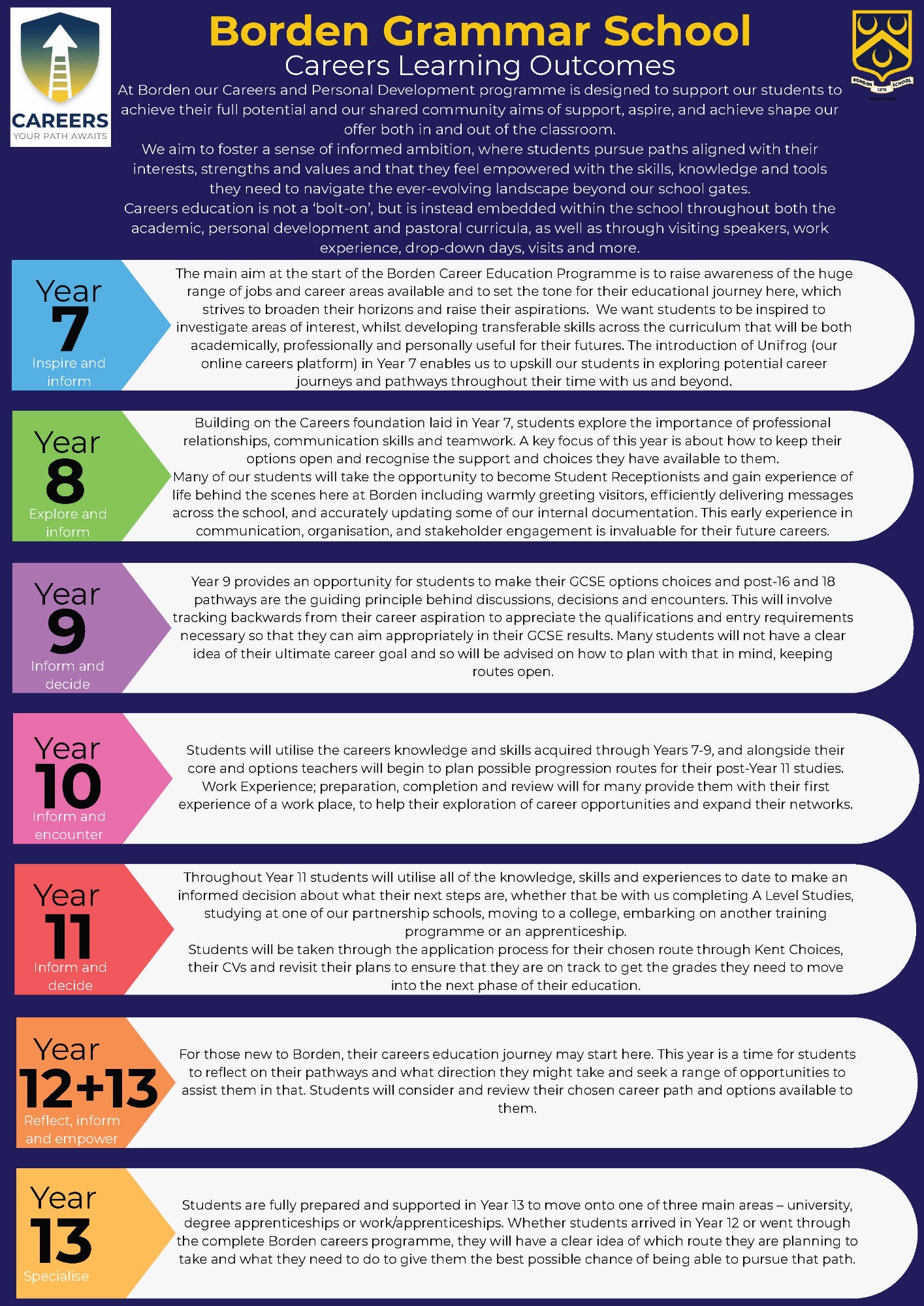
At Borden our Careers and Personal Development programme is designed to support our students to achieve their full potential and our shared community aims of support, aspire, and achieve shape our offer both in and out of the classroom.

We aim to foster a sense of informed ambition, where students pursue paths aligned with their interests, strengths and values and that they feel empowered with the skills, knowledge and tools they need to navigate the ever-evolving landscape beyond our school gates.

Careers education is not a ‘bolt-on’, but is instead embedded within the school throughout both the academic, personal development and pastoral curricula, as well as through visiting speakers, work experience, drop-down days, visits and more.

Below are the main experiences that a student in each year group can expect to have. Some of the events are targeted for specific students or subject areas, but most are universal and apply to the whole year group.


Year 7: Inspire and Inform

The main aim at the start of the Borden Career Education Programme is to raise awareness of the huge range of jobs and career areas available and to set the tone for their educational journey here, which strives to broaden their horizons and raise their aspirations. 

We want students to be inspired to investigate areas of interest, whilst developing transferable skills across the curriculum that will be both academically, professionally and personally useful for their futures.

The introduction of Unifrog (our online careers platform) in Year 7 enables us to upskill our students in exploring potential career journeys and pathways throughout their time with us and beyond.

Activities include:

  • Open Evening for prospective students

  • Open Mornings

  • Transition Day

  • Personal Development lessons on career exploration 

    • Introduction to Careers: MyPath

    • Unifrog 101

    • What is a Career? (Individual Project)

    • Creativity: MyPath

  • Termly Careers Form Time Focus

  • Meaningful encounters: DS Smith and Kent Fire and Rescue Service


Year 8: Explore and Inform

Building on the Careers foundation laid in Year 7, students explore the importance of professional relationships, communication skills and teamwork. A key focus of this year is about how to keep their options open and recognise the support and choices they have available to them.

Activities include:

  • Personal Development lessons on Careers

    • Building relationships: MyPath

    • Communication: MyPath

    • Careers Portfolio (Individual Project)

    • Teamwork: MyPath

    • Apprenticeships: MyPath

    • Labour Market Information: MyPath

    • Choosing Options: MyPath

  • Termly Careers Form Time Focus

  • Meaningful encounter: Employers: DS Smith

  • Student Receptionists


Year 9: Inform and Decide

Year 9 provides an opportunity for students to make their GCSE options choices and post-16 and 18 pathways are the guiding principle behind discussions, decisions and encounters. This will involve tracking backwards from their career aspiration to appreciate the qualifications and entry requirements necessary so that they can aim appropriately in their GCSE results. Many students will not have a clear idea of their ultimate career goal and so will be advised on how to plan with that in mind, keeping routes open.

Activities include:

  • Year 9 Expectations Evening

  • Futures Fair (all invited)

  • Options Evening

  • Personal Development lessons on Careers

    • Apprenticeships: The Nine to Five with Stacey Dooley

    • Unifrog 101 revisited

    • Step into the NHS (Individual Project)

    • Is University right for me? MyPath

  • Termly Careers Form Time Focus

  • Duke of Edinburgh Bronze Award volunteering (some students)

  • Work Experience Launch Assembly

  • T-Levels and Apprenticeships talk from CXK

  • Meaningful encounters: Employers: Kier, Jackson


Year 10: Inform and Encounter

Students will utilise the Careers knowledge and skills acquired through Years 7-9, and alongside their core and options teachers will begin to plan possible progression routes for their post-Year 11 studies. 

Activities include:

  • Year 10 Information Evening

  • Futures Fair (all invited)

  • Personal Development lessons on Careers

    • Apprenticeships: MyPath

    • Labour Market Information: MyPath

    • Balancing Life and Work: MyPath

    • Is University right for me?: MyPath

    • Work Experience: Preparation, Completion (4 days) and Review

  • Termly Careers Form Time Focus

  • Duke of Edinburgh Silver Award volunteering (some students)

  • Meaningful encounters: Employers: Work Experience, Kier

  • Swale District Careers Fair visit (invited students)


Year 11: Inform and Decide

Throughout Year 11 students will utilise all of the knowledge, skills and experiences to date to make an informed decision about what their next steps are, whether that be with us completing A Level Studies, studying at one of our partnership schools, moving to a college, embarking on another training programme or an apprenticeship.

Students will be taken through the application process for their chosen route through Kent Choices, their CVs and revisit their plans to ensure that they are on track to get the grades they need to move into the next phase of their education.

Activities include:

  • One-to-one guidance interviews with CXK

  • Futures Fair (all attend)

  • 6th Form Open Evening

  • Personal Development lessons on Careers

    • Me: So far and now what? SWOT analysis

    • Is University right for me?: MyPath

    • CV Writing: MyPath

    • Recruitment Practices: MyPath


Year 12 & 13: Reflect, Inform and Empower

For those new to Borden, their careers education journey may start here. This year is a time for students to reflect on their pathways and what direction they might take and seek a range of opportunities to assist them in that. Students will consider and review their chosen career path and options available to them.

Activities include:

  • Hearing from a range of guest speakers, including a number of alumni

  • Visit to the UK Universities and Apprenticeships fair at the University of Kent

  • Enrichment lessons (Personal Development and Careers)

  • Targeted interview skills sessions

  • Higher education evening

  • One-to-one careers guidance interviews for all

  • Targeted mentoring

  • Targeted opportunities shared through Google Classroom and email

  • Unifrog software careers exploration

  • Writing personal statements

  • Drop down UCAS Day


Year 13: Specialise

Students are fully prepared and supported in Year 13 to move onto one of three main areas – university, degree apprenticeships or work/apprenticeships. Whether students arrived in Year 12 or went through the complete Borden careers programme, they will have a clear idea of which route they are planning to take and what they need to do to give them the best possible chance of being able to pursue that path.

Activities include:

  • Hearing from a range of guest speakers, including a number of alumni

  • Enrichment lessons (Personal Development and Careers)

  • Targeted interview skills sessions

  • Oxbridge preparation

  • One-to-one careers guidance interviews for all

  • Targeted mentoring

  • Targeted opportunities shared through Google Classroom and email

  • Unifrog software careers exploration

  • Personal statement workshop: University of Reading


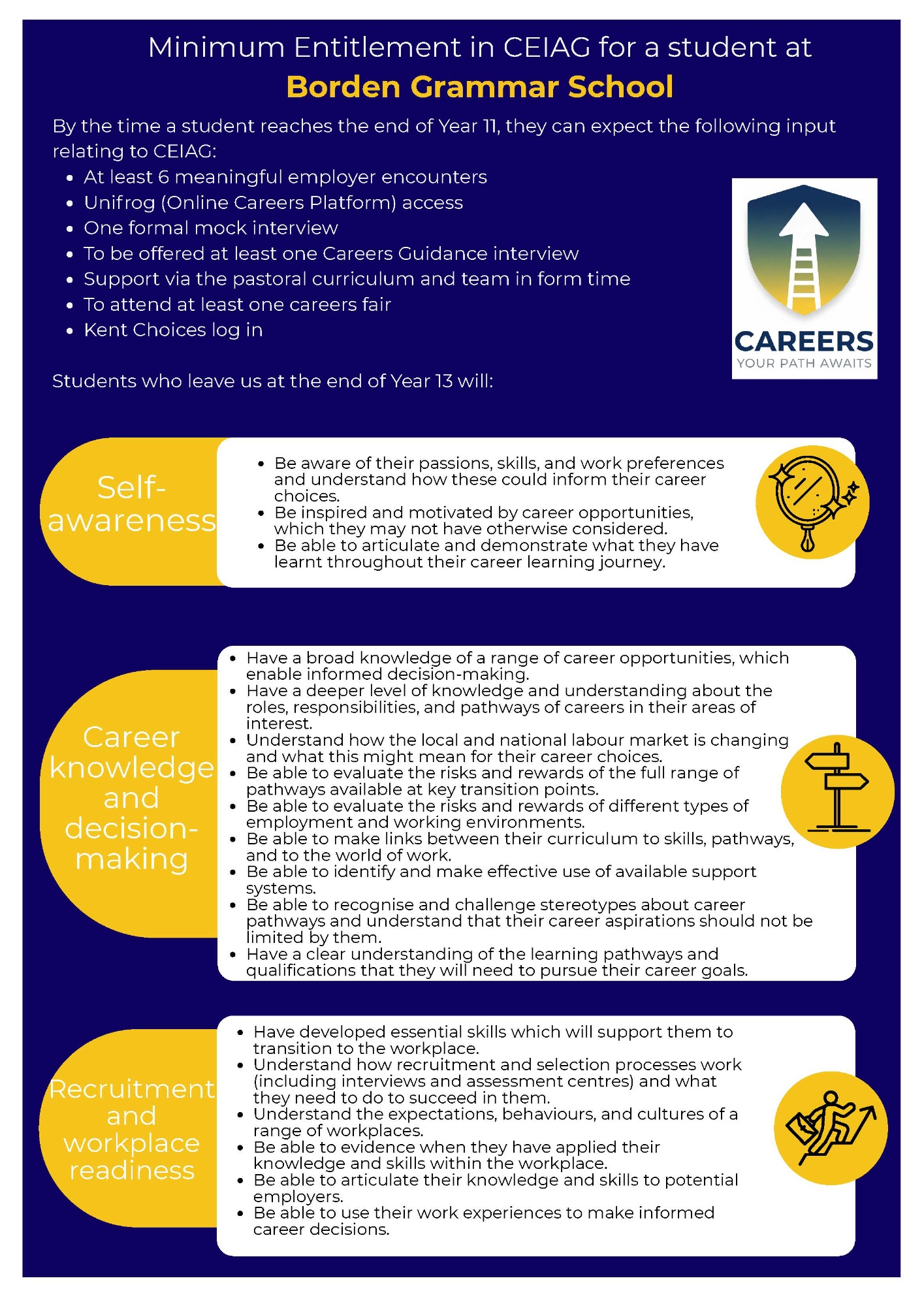
Minimum Entitlement in CEIAG for a student at Borden Grammar School

By the time a student reaches the end of Year 11, they can expect the following input relating to CEIAG:

  • At least 6 meaningful employer encounters

  • Unifrog (Online Careers Platform) access

  • One formal mock interview

  • To be offered at least one Careers Guidance interview

  • Support via the pastoral curriculum and team in form time

  • To attend at least one careers fair

  • Kent Choices log in


Students who leave us at the end of Year 13 will

Self-awareness

  • Be aware of their passions, skills, and work preferences and understand how these could inform their career choices.

  • Be inspired and motivated by career opportunities, which they may not have otherwise considered.

  • Be able to articulate and demonstrate what they have learnt throughout their career learning journey.

Career knowledge and decision-making

  • Have a broad knowledge of a range of career opportunities, which enable informed decision-making.

  • Have a deeper level of knowledge and understanding about the roles, responsibilities, and pathways of careers in their areas of interest.

  • Understand how the local and national labour market is changing and what this might mean for their career choices.

  • Be able to evaluate the risks and rewards of the full range of pathways available at key transition points.

  • Be able to evaluate the risks and rewards of different types of employment and working environments.

  • Be able to make links between their curriculum to skills, pathways, and to the world of work.

  • Be able to identify and make effective use of available support systems.

  • Be able to recognise and challenge stereotypes about career pathways and understand that their career aspirations should not be limited by them.

  • Have a clear understanding of the learning pathways and qualifications that they will need to pursue their career goals.

Recruitment and workplace readiness

  • Have developed essential skills which will support them to transition to the workplace.

  • Understand how recruitment and selection processes work (including interviews and assessment centres) and what they need to do to succeed in them.

  • Understand the expectations, behaviours, and cultures of a range of workplaces.

  • Be able to evidence when they have applied their knowledge and skills within the workplace.

  • Be able to articulate their knowledge and skills to potential employers.

  • Be able to use their work experiences to make informed career decisions.